
Storytelling and designing the journey through exhibition design
Navig8 has recently been commissioned to design an exhibition in a rather splendid space in Stratford.
The space features huge, movable panels – floor-to-ceiling – that can be repositioned, combined, and separated, offering the opportunity for a viewer to move through the space.
Additionally, there are 11 street-facing panels that a viewer can walk along, inside the building; each over a meter in width. I call it the ‘long walk'.Amongst these panels are 3 AV screens, and there is also a large wall space found in the amphitheatre.
We undertook a detailed site survey and recognised the opportunities for storytelling and movement through this space.
Understanding the story
I can’t divulge the client at the moment, but without any spoilers or breaking confidentiality, I'll tell you what I can.
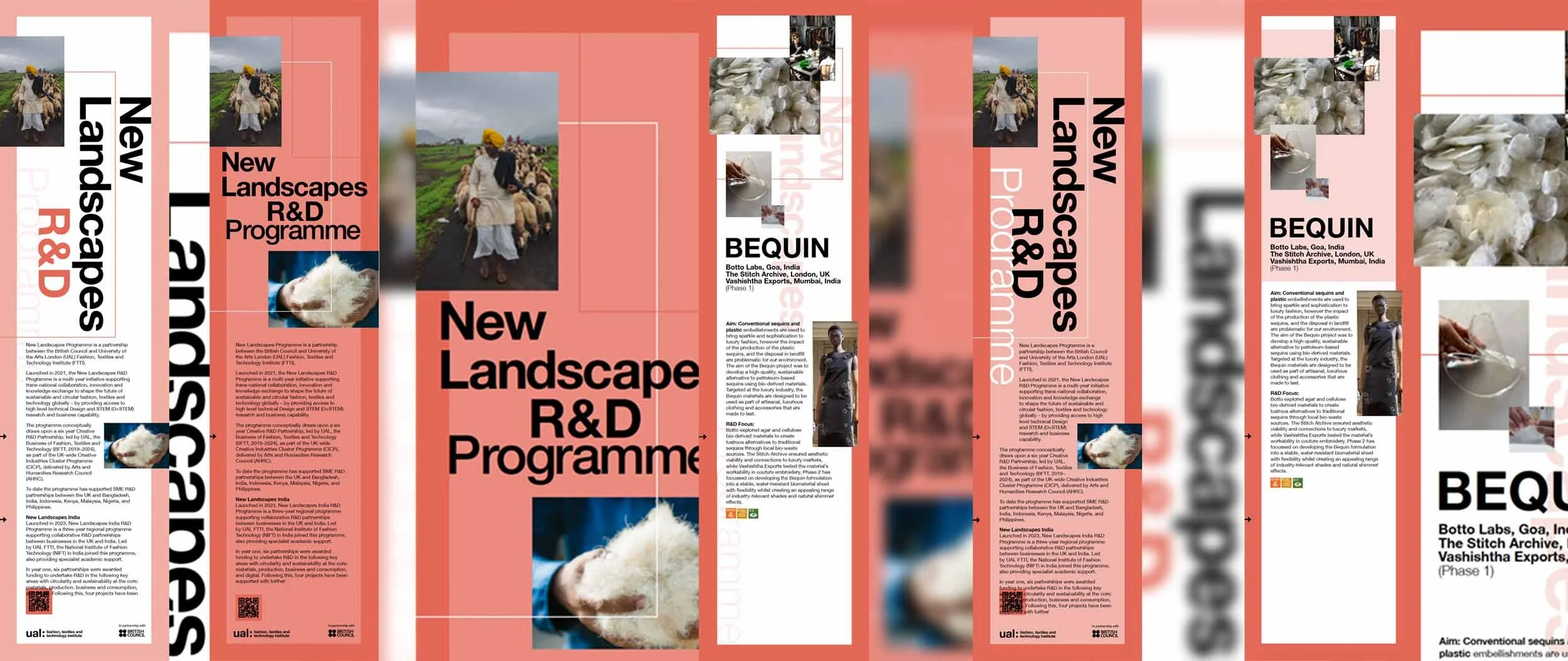
A large UK-based organisation has a programme with small, international ‘manufacturers’ who produce sustainable, innovative materials and dyes for the fashion industry.
Each producer has a story to tell. The programme has a story to tell.
Our first job, then, is to educate ourselves on the content. We reviewed all the draft content and advised the client on the proposed content structure and the volume that any of the panels could accommodate.
For the best results when putting content together for any exhibition – large or small – even down to a single pull-up stand is to define a hierarchy for the content.
This should consist of:
A headline to draw the viewer in
A more detailed narrative, but not too detailed
A CTA, or call to action
The first point engages the viewer who is likely to see the panel from a distance (this does not apply to the ‘long walk’ panels, as the viewer cannot stand very far away from them), so the headlines must be legible from the first point of view.
The second point combines the written text and images.
The third is often a QR code to drive the viewer to a website or even a link to a PDF.
There is always a tendency to overload the panels with text. This should be avoided. As anyone who visits a gallery will know, few people stop to read any lengthy text.
The deeper understanding we have of the content, the better we can maximise the engagement.
The space
We know from our site visit that visitors enter from one door, and they can be visually directed through and past the main panels and around to the ‘long walk’. The amphitheatre poses a more difficult problem, but we’ll deal with that; not to worry.
The AV screens are positioned in the main gallery, the cafe and next to reception, adjacent to the amphitheatre. Handy that.
We want to design the space to take the viewer by the hand around the space to a final conclusion; the amphitheatre.
We do that by making the space guide the viewer, reinforcing their path with floor stickers.
There are several physical objects that will also be displayed, set upon plinths with perspex hoods.
Design
Designing an exhibition requires an understanding of the size and space. In this instance, it is a big space. The designer must set up the artwork with certain considerations in mind.
We set up the templates to include an indicating line that shows where the average person’s eye line falls. Another line demonstrates where the top of the plinths will sit.
I can’t tell you the times I have seen exhibition designs with content below the viewer's knees or under a table.
To know how the viewer will see the work is the most important aspect that informs the design. When we design the panels, we view the documents at a small size, but we must be conscious of designing optimally for how the viewer will see them.
The main gallery panels are split into two areas, one set behind the other. The viewer can walk through the first set of panels and around the second set as they are guided to the ‘long walk' gallery.
The first set of panels tells the story of the programme, and when following the route set out through the remaining spaces, each following panel tells the individual stories.
As I have said, these panels face out to the street whilst being situated inside the building, so they need to be designed to be viewed from both a reasonably close-up range and also from a viewer positioned on the street. The AV screens push the narrative and the visitor forward until they come to the amphitheatre.
Here we close the story of the show, and if the visitor is present for other reasons outside of viewing the exhibition, they can proceed to the separate reception area.
We take care of the RAMS, H&S, floor coverings, barriers, installation and deinstillation – everything.
Exhibition design requires a unique set of skills and understanding. Our team has those skills.